

NEWYou can now listen to Fox News articles!
The Supreme Court on Monday weighed the legality of President Donald Trump’s attempt to fire a member of the Federal Trade Commission without cause, in a blockbuster legal fight that justices noted could fundamentally reshape the balance of powers across the federal government, and impact at least two dozen federal agencies.
Justices on the high court appeared split over how to proceed in the case, which involves Supreme Court precedent set in Humphrey’s Executor, a 1935 decision that allowed Congress to protect certain federal regulators from being removed by a sitting president without cause.
U.S. Solicitor General D. John Sauer urged the Supreme Court justices at the outset of oral arguments Monday to overturn Humphey’s, which he assailed as an “indefensible outlier” and “decaying husk” of a Supreme Court decision that has “not withstood the test of time.”
Lawyers for ousted FTC member Rebecca Slaughter countered that overturning the 1935 decision altogether would mean that “everything is on the chopping block,” both for leaders of the FTC and for other multi-member federal agencies created by Congress.
As arguments drew to a close, it remained unclear how the high court might rule. Most conservatives appeared to disagree with the notion that Congress should be able to block a president’s ability to fire federal regulators — even as they nodded to the risks of overturning the 1935 decision entirely.
Chief Justice John Roberts used his time to press parties on how modern-day FTC authorities have changed since the court’s original decision, which might allow justices to keep in place some of the underlying tenets of Humphrey’s Executor.
Justices Brett Kavanaugh and Amy Coney Barrett seemed to entertain the possibility of further narrowing protections for agency heads under Humphrey’s, if not overturning it altogether, and pressed counsel for the Trump administration on what “limiting” principles might apply.
LAWYERS FOR COOK, DOJ TRADE BLOWS AT HIGH-STAKES CLASH OVER FED FIRING
Supreme Court justices attend Trump’s inaugural ceremony on Jan. 20, 2025, at the U.S. Capitol in Washington, D.C. (Ricky Carioti /The Washington Post via Getty Images)
Liberal justices on the court appeared skeptical of Sauer’s claim that Trump has the power to fire the heads of independent federal agencies, citing concerns that allowing him to do so here could be a slippery slope that frees the executive to fire other agency heads, or lower-level civil servants.
“You’re asking us to destroy the structure of government,” Justice Sonia Sotomayor told Sauer shortly after oral arguments kicked off. “Where else have we so fundamentally altered the structure of government?”
“You’re asking us to overturn a case that has been around for nearly 100 years,” she said, adding: “I don’t see how your logic can be limited,” if Humphey’s is overturned.
Justice Elena Kagan echoed the same concerns. “Once you’re down this road, it’s a little bit hard to see how you stop,” she said.
The case, Trump v. Slaughter, centers on Trump’s firing of Federal Trade Commission member Rebecca Slaughter, a Democrat, without cause earlier this year.
Slaughter sued immediately to challenge her removal, arguing that it violated protections the Supreme Court enshrined in Humphrey’s Executor.
The 1935 precedent, and questions of separation of powers, drove the bulk of arguments Monday.
The case also comes as the high court gears up to hear a case next month centered on Trump’s attempt to remove Federal Reserve Governor Lisa Cook.
The arguments in Monday’s case will be closely watched and are expected to inform how the court might consider that case in January.
SCOTUS TO REVIEW TRUMP EXECUTIVE ORDER ON BIRTHRIGHT CITIZENSHIP
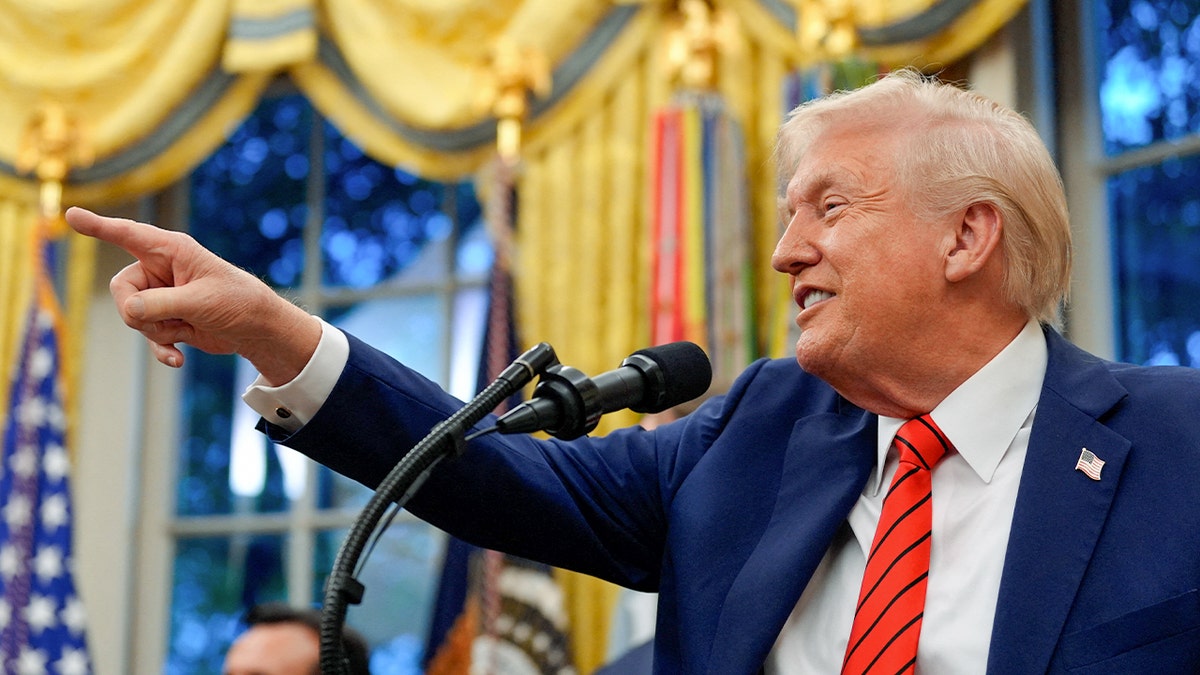
President Donald Trump points a finger during an announcement at the White House in Washington, D.C., Oct. 10, 2025. (Kent Nishimura/Reuters)
Slaughter had sued in March over her removal, arguing that it violates Humphey’s Executor, and a 1914 law passed by Congress, which shields FTC members from being removed by a president except in circumstances of “inefficiency, neglect of duty, or malfeasance in office.”
A federal judge had sided with Slaughter’s lawyers in July, agreeing that her firing unlawfully exceeded Trump’s executive authorites and ordered her reinstated. The Supreme Court in September stayed that decision temporarily, allowing Trump’s firing to remain in effect pending their review.
The Supreme Court’s willingness to review the case is a sign that justices might be ready to do away completely with Humphrey’s protections, which have already been weakened significantly over the last 20 years.
Allowing Humphey’s to be watered down further, or overturned completely, could allow sitting presidents to wield more authority in ordering the at-will firing of members of other federal regulatory agencies, including the National Labor Relations Board and the Securities and Exchange Commission, among others, and replacing them with persons of their choosing.
APPEALS COURT BLOCKS TRUMP FROM FIRING FEDERAL BOARD MEMBERS, TEES UP SUPREME COURT FIGHT
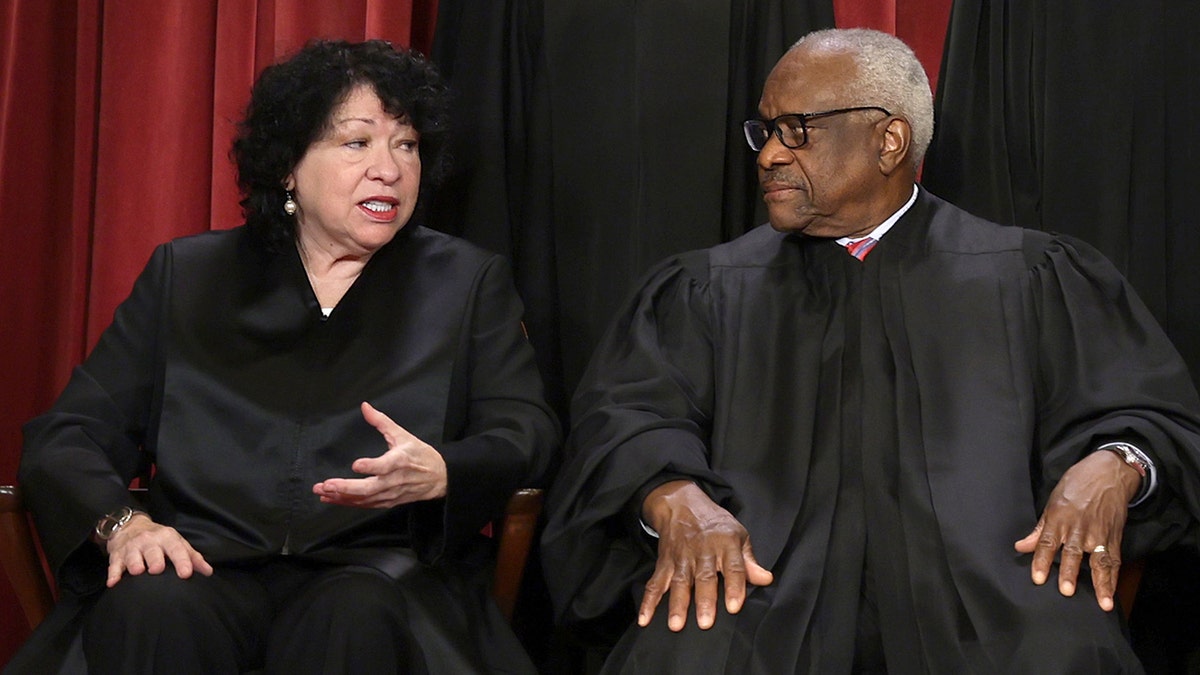
Supreme Court Justices Sonia Sotomayor and Clarence Thomas are seen in the Supreme Court building in Washington, D.C. (Alex Wong/Getty Images)
The six conservative justices on the high court signaled as much when they agreed to review the case earlier this year. (Justices split along ideological lines in agreeing to take up the case, with Justices Elena Kagan, Sonia Sotomayor and Ketanji Brown Jackson dissenting.)
They asked both parties to come prepared to address two key questions in oral arguments: First, whether the removal protections for FTC members “violates the separation of powers and, if so, whether Humphrey’s Executor, should be overruled,” and whether a federal court may prevent a person’s removal from public office, “either through relief at equity or at law.”
U.S. Solicitor General D. John Sauer argued in a filing that the FTC authorities of today vastly exceed the authorities granted to the commission in 1935.
“The notion that some agencies that exercise executive power can be sequestered from presidential control seriously offends the Constitution’s structure and the liberties that the separation of powers protects,” he said.
A decision is expected to be handed down by the end of June.
SUPREME COURT SIGNALS IT MAY LIMIT KEY VOTING RIGHTS ACT RULE

Federal Trade Commission Commissioners Rebecca Kelly Slaughter and Alvaro Bedoya chat during a House Judiciary Committee hearing on Capitol Hill in Washington, D.C., on July 13, 2023. (Shuran Huang for The Washington Post via Getty Images)
The case, Trump v. Slaughter, is one of four cases the Supreme Court’s conservative majority has agreed to review this term that centers on key separation of powers issues, and questions involving the so-called unitary executive theory.
Critics have cited concerns that the court’s decision to take up the cases could eliminate lasting bulwarks in place to protect against the whims of a sitting president, regardless of political party.
It also comes as justices for the Supreme Court’s 6-3 conservative majority have grappled with a flurry of similar lawsuits filed this year by other Trump-fired Democratic board members, including Gwynne Wilcox of the National Labor Relations Board (NLRB) and Cathy Harris of the Merit Systems Protection Board (MSPB).
CLICK HERE TO DOWNLOAD THE FOX NEWS APP
Since taking office, Trump has signed hundreds of executive orders and ordered sweeping personnel actions that have restructured federal agencies and led to mass layoffs across federal agencies, including leaders that were believed to be insulated from the whims of a sitting president.