
Israel’s military said it targeted Iranian nuclear facilities and research scientists in dozens of preemptive airstrikes early Friday morning local time, the first wave of what it said could be a days-long attack — and leading Iran to launch a wave of more than 100 drones at Israeli in retaliation. The Israel Defense Forces said its air defenses were “working to intercept the threats.”
The Iranian drones could take up to several hours to reach Israel’s airspace, but Israel has previously intercepted Iranian weapons before they get that close.
In a video statement, Israeli Prime Minister Benjamin Netanyahu described Israel’s strikes — dubbed “Operation Rising Lion” — as “a targeted military operation to roll back the Iranian threat to Israel’s very survival.”
Iranian state television said the head of the Islamic Revolutionary Guard Corps, Hossein Salami, was killed in the strikes, as was Maj. Gen. Mohammad Bagheri, chief of the staff of the Iranian Armed Forces.
Netanyahu said the strikes “will continue for as many days as it takes to remove this threat.”
IDF Spokesperson Brigadier General Effie Defrin said in a televised statement on Friday morning that “200 fighter jets went on the attack and dropped over 330 different munitions” on more than 100 targets in Iran, beginning Operation Rising Lion. He said the IDF had confirmed that “senior members of the Iranian regime’s security leadership” had been killed, including the Iranian military’s chief of staff and the Revolutionary Guard’s Salami.
Deffrin said Israel had launched its operation “at the most appropriate time in light of an existing and real threat and with the highest military readiness,” claiming intelligence showed “the Iranian regime has made significant progress in achieving nuclear capability and its ability to act against us,” calling it an emerging and existential threat to Israel.
Iranian officials had indicated they planned to retaliate against Israel. The country’s Supreme Leader, Ayatollah Ali Khamenei, said Israel “should await a harsh response” in a message reported by Iranian state media.
Majid Saeedi/Getty Images
The IDF spokesperson Defrin, in his Friday remarks, provided no further information on the wave of drones launched by Iran, other than saying there were over 100 of them and that “all defense systems are working to intercept the threats.”
U.S. not involved in Israel’s strikes, Rubio says
The United States was not part of the operation and was not involved in intelligence sharing, multiple U.S. sources told CBS News, and Secretary of State Marco Rubio confirmed this in a statement.
“Israel took unilateral action against Iran,” he said. “We are not involved in strikes against Iran and our top priority is protecting American forces in the region. Israel advised us that they believe this action was necessary for its self-defense.”
Rubio added, “Iran should not target U.S. interests or personnel.”
President Trump told Fox News’ Bret Baier late Thursday he was aware of the strikes in advance, but the U.S. did not assist Israel militarily.
Mr. Trump is convening a National Security Council meeting in the Situation Room on Friday, the White House said.
The U.S. Embassy in Israel told government employees and their families to “shelter in place until further notice,” amid the threat of a retaliatory strike by Iran.
IDF says it hit “dozens” of targets in “first stage”
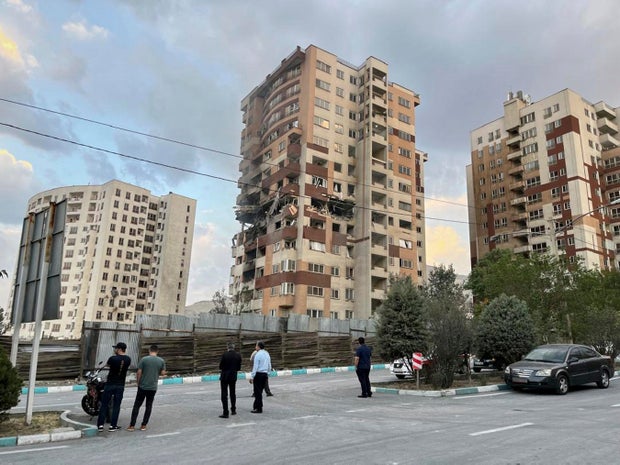
Iranian state media reported loud explosions and some casualties in the capital city of Tehran. State television later reported strikes in several other Iranian cities, including Natanz, which is south of Tehran and home to one of the country’s uranium enrichment facilities.
Ufuk Celal Guzel/Anadolu via Getty Images 
An Israel Defense Forces spokesperson said the military “launched a preemptive, precise, combined offensive based on high-quality intelligence to strike Iran’s nuclear program, and in response to the Iranian regime’s ongoing aggression against Israel.”
The spokesperson said “dozens” of Israeli air force jets struck “dozens of military targets, including nuclear targets in different areas of Iran.” The statement referred to it as “the first stage.”
Strikes come amid U.S.-Iran nuclear talks
The strikes came as the Trump administration has been seeking to negotiate an agreement with Iran’s government to limit the country’s nuclear program. Mr. Trump has said Iran cannot be allowed to enrich uranium, but Iran is unwilling to accept those terms.
The U.S. and Iran are still expected to hold talks on Sunday, multiple U.S. officials told CBS News. Steve Witkoff, the president’s Mideast envoy, was planning to hold a sixth round of talks in Oman over the weekend.
Mr. Trump told Fox News, “Iran cannot have a nuclear bomb and we are hoping to get back to the negotiating table. We will see.”
Israel has long been skeptical of striking a deal with Iran, its top global foe, and has acknowledged carrying out various covert and overt actions over the years to set back Iran’s nuclear ambitions.
Iran’s nuclear program has existed for decades, though the country denies that it has any interest in building a nuclear weapon. International watchdogs say Iran has increased its stockpiles of highly enriched uranium in recent years, after Mr. Trump withdrew from a 2015 Obama-era nuclear agreement that he viewed as weak.
In a statement announcing the strikes, the IDF said Iran “is closer than ever to obtaining a nuclear weapon” and “has proclaimed that its objective is to destroy the State of Israel.” Israel also cited Iran’s support for militant groups in the region, including the terrorist group Hamas, and Iran’s ballistic missile attacks on Israel last year.
CBS News reported Wednesday that Israel was ready to launch an operation on Iran. The U.S. anticipated Iranian retaliation on American sites in Iraq — leading the Trump administration to advise non-emergency U.S. government officials and military families to leave the entire region.
When asked about those precautionary measures for U.S. nationals in the Mideast, Mr. Trump said only that the region “could be a dangerous place, and we’ll see what happens.”
If the U.S remains uninvolved in the strikes, it means Israel’s operation will not include B-2 bombers, which carry heavy bombs that can penetrate Iran’s deep underground fortified uranium enrichment facilities. As a result, a lack of U.S. participation could limit Israel’s ability to fully eliminate Iran’s nuclear program.
Michal Ben-Gal and Seyed Bathaei contributed to this report.
Vahid Salemi / AP