Hey everyone,
Seventeen days in October told us a lot about the next phase of the AI buildout, and it’s not insignificant.
On October 14, CoreWeave fell 15% in a single day as its bonds started trading like distressed debt. By October 20, its 2031 notes were at 79 cents on the dollar. On October 25, Elon Musk posted on X that debt markets had almost entirely cut off money to any company without substantial revenue outside AI data centers. The next day, Meta launched what became a $97.5B equity raise, and Anthropic filed an S-1 for an IPO that could raise $100B or more. On October 29, Microsoft sold $25B of bonds, its first US dollar deal since 2017, and drew $115B of orders. On October 30, OpenAI, according to reports, received only $11B of interest from a planned $30B round. It said it would turn to family offices and wealthy individuals to reach a reduced $20B target.
The AI buildout has hit a new bottleneck, and it sits underneath all the others. For three years, the constraints were physical: GPUs, CoWoS, HBM, power, turbines. Now the constraint is capital.
Not capital for the hyperscalers. They still generate hundreds of billions of dollars in operating cash flow and can borrow at about one percentage point over Treasuries. What is running out is other people’s money: the external debt and equity that funded everything outside the balance sheets of Amazon, Microsoft, Google and Meta.
That distinction matters more than most investors realize, because the part of the buildout that runs on other people’s money is bigger than it looks.
The cycle is about to get slower, more selective, and more concentrated, and that changes who wins. In this article, I share my capital-constrained model for 2027 AI capex by industry, and it looks very different from what the Street is estimating.
In this article, I cover:
-
How the CoreWeave credit selloff became the first crack in the neocloud funding model
-
Elon Musk’s comments on neoclouds and SpaceX’s +10GW plan for 2027
-
How Meta, Microsoft and Alphabet are crowding out the weaker borrowers
-
Why the Anthropic IPO and OpenAI’s pivot to family offices signal the end of easy external capital
-
A model of 2027 AI capex: and what it means for layers like the semis, neoclouds and the hyperscalers
-
What could reopen the capital window
Let’s dive in.
The CoreWeave moment: credit stopped believing the story
The first crack did not show up in GPU orders or token volumes. It showed up in the bond market, which a lot of times is where the truth shows up first.
On October 14, a hotter-than-expected September CPI print pushed up rate hike expectations. The same day, a discussion about a $1.25B batch of CoreWeave bonds went viral. CoreWeave closed down 15.46% at $65.78, and Oracle fell 7.3% in sympathy. From there it snowballed:
• Bond prices. CoreWeave’s 9.75% notes due 2031 yielded 15.78% on October 15. By October 20, the October 2031 notes were at 79.46 cents on the dollar and the June 2030 notes at 83.10.
• Default insurance. The five-year CDS spread topped 1,140 basis points intraday. It is up 179% over the past year and 39% in October alone.
• Equity. The stock was down 36% in October as of the 21st, putting the market cap at roughly $31B vs. a peak of about $90B.
When a bond with a 9.75% coupon trades at 79 cents, the market is saying: “I will only lend to you today if I earn ~16% a year.” A 1,140bps CDS spread means it costs 11.4% of the face value per year just to insure the debt against default. Those are not AI-growth-company numbers. Those are distressed-credit numbers.
Why now? Because the math was always tight, and the rate environment stopped forgiving it. In Q2 2026, CoreWeave grew revenue 112% YoY to $2.575B, but net interest expense was $640M, about 25% of revenue, and the company lost $626M. Interest alone was bigger than the net loss. As of June 30, it carried $35.6B of debt principal plus $16.3B of operating lease liabilities, with another ~$35.5B of leases not yet commenced. S&P rates it B+, which is junk.
Now, adding the macro on top: the 10-year Treasury is around 5.12%, the Fed funds rate sits at 3.75–4.00%, and in a Reuters poll, all respondents expect a hike in December. A business model built on borrowing at 9–10% to rent out GPUs that depreciate over five to six years looks very different when the marginal dollar costs 15%+.
It did not stay a CoreWeave problem. Firmus withdrew its planned ~$5B Australian IPO on October 9. This is the same Firmus that needed Nvidia’s revenue-share backstop in July.
• Nebius still got money, but look at the terms. Its July facility was a four-year loan at SOFR + 2.50%. Its October Citi facility of $3.5B is a 364-day bridge at SOFR + 2.75%, able to step up to 3.50%. Tenor went from four years to one, and price went up. CEO Arkady Volozh admitted that asset-backed financing and debt markets had temporarily dried up.
• IREN got $2.4B of Blue Owl equipment financing at 9%, maturing just two and a half years after funding.
• Oracle, the most neocloud-like of the large caps, was downgraded by S&P to BBB- in July, the last rung of investment grade. In fiscal Q1 FY27 (Jun–Aug 2026), it generated ~$23B of operating cash flow and still had -$5B of free cash flow.
Goldman did upgraded CoreWeave to Buy on October 19, JPMorgan called the worries overblown, and management keeps pointing to a $104B backlog. But a backlog is not cash, and in credit, the question is never “is there demand?” It is “who gets paid first if something goes wrong, and at what price?” In October, the market answered that question for the first time.
SpaceX and Elon’s comment on the state of the neocloud market
On Sunday, October 25, replying to Chamath Palihapitiya, Elon Musk posted that SpaceX had closed $40B of debt for GPUs, and credited two things: SpaceX is investment grade, and it has Starlink and launch revenue. In the same post, he said that over the past few weeks, debt markets had almost entirely cut off money to any company without substantial revenue outside AI data centers, and that the 200+ neoclouds are headed for »guppy-level death and consolidation«, with only a few making it through. In a follow-up, he called it »primarily callable debt for GPU purchases that will arrive in Q1 and Q2«. He later added that SpaceX would not buy any neoclouds, calling the idea »pointless«.
I think Elon’s post is important for two reasons, and only one of them is the obvious one.
The obvious reason: he is right about the direction. The people closest to the neocloud business are saying the same thing, just more politely. At Nvidia’s GTC in Berlin last month, most neoclouds that Fortune’s Beatrice Nolan spoke with agreed that consolidation is coming; Volta’s CFO described it as a massive wave rather than a light one, with M&A starting in the relatively near future. Gartner now predicts that 80% of independent neoclouds will cease independent operations by 2030, and Bernstein estimates that only 35% of announced North American data center capacity will actually get built.
Elon was also describing his own problem. He posted that the deal had closed two days after Bloomberg reported it had hit obstacles. People familiar with the talks told Bloomberg that, as of Sunday night, pricing was still being negotiated and the deal had not priced. Semafor reported that the lowest-rated piece was expected at about 8.3% and the chip-backed piece at about 7.75%, more than 1 percentage point above where SpaceX’s existing bonds trade. And the structure is not plain corporate debt at all: it is an off-balance-sheet GPU lease through an Apollo-managed vehicle, built so the borrowing does not hit SpaceX’s investment-grade ratings.
So the message I take from the post is not “SpaceX is fine, neoclouds are not.” It is: even the best-capitalized AI infrastructure builder outside the hyperscalers had to pay up, restructure, and push the deal off balance sheet to get $40B done. That is the same direction the neoclouds are going, just from a much stronger starting point.
On its Q3 call (October 20), SpaceX said it had 1.7GW of nameplate compute at September 30, up from 0.6GW a year earlier. It guided to 2.5–3GW by the end of 2026 and then dropped the at least 10GW of incremental compute in 2027, roughly 13GW by year-end, with a stretch goal of 20GW, and a 440,000-unit Vera Rubin training cluster targeted for the end of Q2 2027. Elon also floated $500B–$1T of annual recurring revenue by the end of 2027, which the company itself frames as an aspiration, not guidance.
The operating momentum is real. Q3 revenue was $14.6B, up 161% YoY. The SI (AI) segment did $7.56B, up 830%, and turned an operating profit for the first time. Q1 2027 revenue is guided to $33–37B. But the important point is that the whole revenue complex hinges on top compute deals that SpaceX did with Anthropic and Google, which both are done at much higher prices than both companies are paying otherwise (S-1 proves it), on top of both deals being short-term deals, meaning both sides can cancel the deal without issues in a quarter, which is much different from hyperscaler revenue that has a multi year commitment in the contract.
Leaving the current operating income aside the 10GW plan costs A LOT. Jensen said at GTC Berlin that a preassembled Vera Rubin AI data center costs around $50B per gigawatt. SpaceX has committed to building exclusively on Nvidia, so 10GW implies roughly $500B of AI capex in a single year. For context, that is more than double what any single hyperscaler is spending this year (Amazon up to $220B, Alphabet up to $205B, Microsoft ~$175B), and about 83% of all three combined (~$600B).
Now the cash side:
• Operating cash flow: $13.1B in the first nine months of 2026 vs. $48.1B of capex. TTM OCF is $15.8B vs. $55.0B of capex, so TTM free cash flow is -$39.2B.
• Liquidity: $51.3B of cash plus $38.6B of securities ($89.9B), almost all of it from the $85.7B of net IPO proceeds in June. Q4 capex alone is guided at $35–40B.
• Debt: $38.0B of principal, including $25B of inaugural notes priced in June at a 5.855% weighted coupon, plus $12.9B of related-party sale-leaseback debt to Valor.
• Customer concentration and fragility: one customer (Customer B) was 34.5% of Q3 revenue. Cloud services agreements are terminable on 90 days’ notice.
That last line is the one I would underline twice. Lenders finance data centers against contracted cash flows. Nebius can point to $40B+ of investment-grade customer commitments. SpaceX’s compute revenue sits on contracts that can be walked away from in a quarter, and a third of revenue comes from one buyer. That is great for pricing power in a shortage. It is terrible collateral for a credit committee.
Here is a simple, illustrative funding bridge for the 10GW plan. The assumptions are mine and generous on purpose:
Even if I cut the cost to $35B per GW (not every gigawatt will be a full Vera Rubin build), the gap is still ~$160B. To close it, SpaceX would need to do roughly four to eight more deals the size of the one that just took three weeks, a re-pricing and an off-balance-sheet structure to get across the line. In a market where its own bonds have weakened, and its CDS has widened.
The equity window is not much better. SPCX closed at $134.72 on October 30, down 40% from its $225.64 high in June, and staged lockup releases run through Q2 2027. Issuing hundreds of billions of new stock into supply that is already coming is a hard sell. The possible Tesla combination, which both boards are evaluating, is the wildcard here as a balance sheet to lean on, but there are no terms yet plus Tesla doesn’t make a ton of operating cash flow by itself so the lift there would be very limited. Among other things, Elon is very creative and has a gift for attracting capital, but this time the capital is really enormous, and I think more projection here and a good word won’t be enough.
My view: SpaceX will build a lot in 2027, but not 10GW. My base case is roughly 3GW, or about $145B of capex (see the 2027 model below), and the shortfall will be a funding story, not an engineering one. Elon himself said power and cooling are the constraint. I think the binding constraint will turn out to be the credit committee. Deutsche Bank already models closer to ~6GW exiting 2027, but I think that even that is too bullish.
Quality is crowding out leverage
Here is the part of the story that I think most investors are underestimating. In the same two weeks that CoreWeave’s bonds went to distressed levels, the best borrowers in the world went to market and took a lot of money off the table:
• Meta launched its largest-ever equity raise on October 26 and upsized it a day later to $97.5B: $25B of common stock at $625 per share, $12.5B of mandatory convertible preferred, and a $60B at-the-market program starting after its new non-voting Class C shares list in Q1 2027. Nvidia put in $3B and AMD $1B. Zuckerberg told investors Meta would need to raise »hundreds of billions of dollars« over several years. In Q3, Meta’s capex of $34.9B was already above its operating cash flow of $32.8B.
• Microsoft priced $25B of bonds on October 29 across 10 tranches, its first US dollar bond sale since 2017. Orders hit $115B, 4.6x the deal size, and the 2066 bond priced at just 1.05 percentage points over Treasuries. It did this with $64.5B of cash on hand, because fiscal Q1 FY27 (Jul–Sep 2026) cash capex was $39.4B and fiscal Q2 capex is guided above $50B.
• Alphabet had already done an upsized $84.75B equity raise in June and a $25B bond in August.
In total, hyperscalers and data center developers have issued more than $313B of investment-grade bonds in 2026, nearly 3x 2025. Add Alphabet’s and Meta’s equity programs (~$182B), SpaceX’s ~$86B IPO in June, and Anthropic’s IPO (next section), and you get roughly half a trillion dollars of AI-related equity supply in about five months.
Now think about it from the seat of a credit or equity portfolio manager. Your “AI infrastructure” allocation is not infinite. You have a risk budget and a concentration limit. Every dollar of Microsoft 40-year paper or Meta stock you buy is a dollar you do not lend to a B+ neocloud. And when you can get AAA Microsoft, whose core business generated $58B of operating cash flow in a single quarter, the only reason to lend to a neocloud is a much higher rate.
The market is already pricing that ladder very precisely:
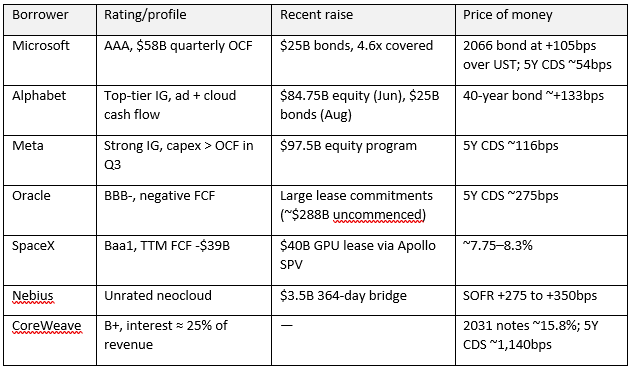
Microsoft’s new bonds carry coupons of 4.85% to 6.35%; CoreWeave’s paper yields ~16%. That is a gap of roughly 10 percentage points per year. On a $1B GPU cluster, it is the difference between ~$50–65M and ~$160M of annual interest, on an asset that has to pay for itself in five to six years.
This is what I mean by quality crowding out leverage. The hyperscalers are not just funding their own buildout; by soaking up investor appetite at the top of the ladder, they are raising the cost of capital for everyone at the bottom. And notice who stepped in as anchor investors in Meta’s raise: Nvidia and AMD. When suppliers have to help fund the demand of their best customers, the external pool is thinner than the headlines suggest.
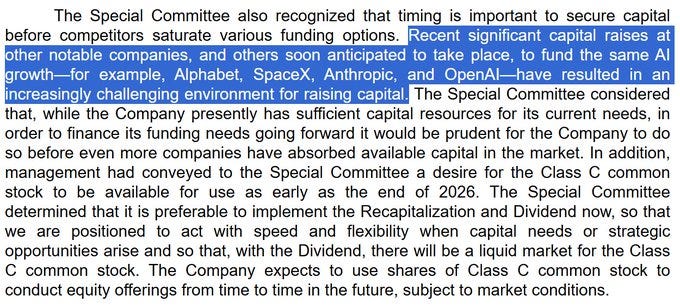
This type of behavior and dynamic is already confirmed in Meta’s recent filing for its new share class, where Meta’s Special Committee “recognized that timing is important to secure capital before competitors saturate various funding options”.
The labs are competing for the same dollar
The frontier labs are one of the most important demand engines of this entire buildout. They are the anchor tenants of the neoclouds, a big part of the hyperscalers’ backlogs, and the end customers of SpaceX’s compute business. So the most important capital-markets question is not “can CoreWeave refinance?” It is “can Anthropic and OpenAI keep raising?” October gave us the first real answer.
Anthropic: the biggest IPO ever is also the biggest single draw on equity capital. Anthropic filed its public S-1 on October 26 for a Nasdaq listing under ANT, with the roadshow as soon as the week of November 9. The S-1 leaves the size blank, but the WSJ reports it could raise $100B or more at a $1.5–2T valuation. For scale, that is on top of SpaceX’s ~$86B IPO in June and Meta’s $97.5B program.
The business inside the S-1 is genuinely impressive. H1 2026 revenue was $16.29B, up ~1,300% YoY, and Q2 alone was $11.56B with $974M of operating income.
But the S-1 also tells you how capital-hungry the model is. Minimum guaranteed compute commitments were ~$265.6B at June 30, up from $54.6B at the end of 2025. That includes ~$114B to Google, $110B to AWS and ~$45B to Microsoft, plus $120.5B to SpaceXAI by 2029. Reporting on the draft S-1 put total compute and infrastructure obligations above $600B including a $160B+ Broadcom/Google chip lease.
OpenAI the institutional bid is gone. OpenAI went out in mid-October asking for $30B at a $1.4T valuation. Around October 22 it cut the valuation to $1.25T. By the October 30 commitment deadline, it had only about $11B, less than half the target, after what the WSJ described as tepid interest from some large investors. It has now cut the target to $20B and told shareholders it will spend the coming weeks pitching family offices and high-net-worth individuals to fill the remaining ~$9B.
I want to be careful here, because “OpenAI raised $11B” still sounds like a lot. The signal is not the size, it is the channel. In a healthy market, family offices and wealthy individuals follow institutional rounds; they do not lead them. When the most famous AI company in the world has to go down the investor quality curve to fill a round, it is telling you the deepest pools of capital (pensions, sovereigns, large asset managers) are either full or waiting for a better price.
And OpenAI’s needs dwarf this round. Its own September forecast, reported by the FT, projects $278B of negative free cash flow from 2026 to 2030 against $856B of compute and infrastructure spending. Even at $20B per round, that is 14 rounds in five years, in a market that could not fill one. Adding on top of that it seems that even frontier labs are now in a pricing war, between each other and also the other alternatives pushing them to do so: Google, Meta and the open-source labs, so the need for cash will probably increase.
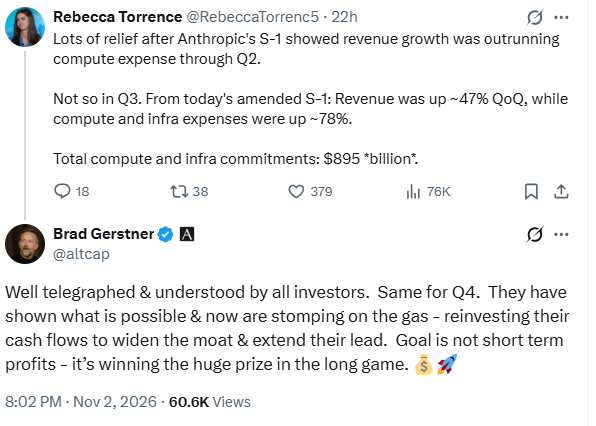
From a post just yesterday on X by Brad Gerstner, who is an investor in both OpenAI and Anthropic (and in my view well informed about these companies), it does seem that Anthropic just wanted to “show a profit” and will now go back into spending mode, which questions how much operating cash flow they will generate if they continue or become more aggressive in the pricing war.
Anthropic and OpenAI explicitly saw themselves competing for the same pool of institutional money; OpenAI reportedly wanted commitments locked in before Anthropic listed. A $100B Anthropic IPO in November will absorb a big share of the crossover and long-only appetite for “AI exposure” for at least a quarter. That leaves less for OpenAI’s next round, less for SpaceX’s next issue, and much less for a neocloud equity follow-on.
The neoclouds are the most exposed link in this chain. Their contracts are largely with the labs, directly or through the hyperscalers. Nscale and Lambda alone have up to $86B of Anthropic commitments. If lenders start to ask whether the labs can keep raising, then every neocloud contract backed by a lab becomes weaker collateral, even if the lab never misses a payment.
Who actually buys Nvidia’s chips, and how they pay for them
This is where the capital story becomes a semis story. Starting in fiscal 2027, Nvidia splits Data Center revenue into two buckets. Hyperscale is the public clouds and the largest consumer internet companies. ACIE (AI Clouds, Industrial & Enterprise) is everyone else: neoclouds, sovereign AI, AI natives, enterprises and industrial customers.

One detail in the Q2 10-Q matters a lot for this article. Nvidia moved one company from ACIE to Hyperscale »due to a change in their business model« and recast prior periods. Nvidia did not name it at that time but at a recent podcast Jensen himself named that company to be SpaceX. SpaceX was roughly $5.2B of Nvidia revenue in Q1 FY27 and about 5% of Q2 revenue, or about $4.8B. If SpaceX had stayed in ACIE, the bucket would have grown 160% YoY instead of 138%. On the recast numbers, ACIE grew 25% sequentially vs. 13% for Hyperscale.
The reclassification changes how you should read both buckets
First, “Hyperscale” is no longer a proxy for the big four. It now contains SpaceX at ~$5B a quarter and, very likely, Oracle as a public cloud. Strip SpaceX out and Amazon, Microsoft, Google and Meta account for at most ~$43.9B, or ~49% of Data Center revenue, before Oracle is even removed. The four buyers with the strongest balance sheets are already less than half of Nvidia’s biggest business.
Second, ACIE without SpaceX is more of a neocloud bucket than its name suggests. Nvidia does not disclose the split, but the evidence points one way:
• Nvidia’s own description of ACIE growth lists »hyperscalers utilizing AI clouds« as a driver. That is Microsoft and Meta renting capacity from Nebius, IREN or Nscale: neocloud capex by definition.
• Sovereign AI largely runs through regional neoclouds. On the Q2 call, Nvidia described sovereign revenue as business through regional neoclouds, up 35% sequentially and more than tripled YoY. Firmus in Indonesia and Sharon AI in Australia, both on Nvidia revenue-share backstops, are exactly this type.
• The labs buy through neoclouds. Anthropic alone has up to $86B committed to Nscale and Lambda.
• Enterprise on-prem and industrial are the slowest-moving parts of the bucket, and nothing in Nvidia’s commentary suggests they drive it.
My estimate is that neoclouds, including the regional neoclouds that deliver sovereign AI, are ~65–75% of ACIE, or ~$26–30B in Q2. Put the pieces together:
• ACIE plus SpaceX was ~$45B in Q2, or ~51% of Data Center revenue, from buyers who need external debt or equity to keep buying. Adding Oracle pushes it higher.
• Neoclouds plus SpaceX alone were ~$31–35B, or ~35–39% of Data Center revenue. That is the most credit-sensitive third of Nvidia’s largest business, and it is the part Elon says lenders just walked away from.
The faster-growing, more diversified half of Nvidia’s demand is exactly the half that is most exposed to the capital markets. And Nvidia knows it. It has invested more than $7B directly in AI cloud providers and its latest filing shows up to $164.5B of guarantees and commitments tied to land, power, shells and AI cloud agreements. On the Q2 call it announced a partnership with six infrastructure capital providers to raise over $500B for AI buildouts, with Jensen saying Nvidia keeps the option to backstop up to $125B, or 25%. The problem with this is that the market might not give it much focus until it does, and things can spiral.
A supplier with a ~75% gross margin financing its own customers is not, by itself, a red flag. Nvidia has the cash. But it tells you where the marginal dollar of demand is coming from: increasingly, from balance sheets that need someone else’s money. When that money gets more expensive, Nvidia is the one with the most to lose, because it is the one with the most margin to protect.
Modeling 2027: what the capital can actually fund
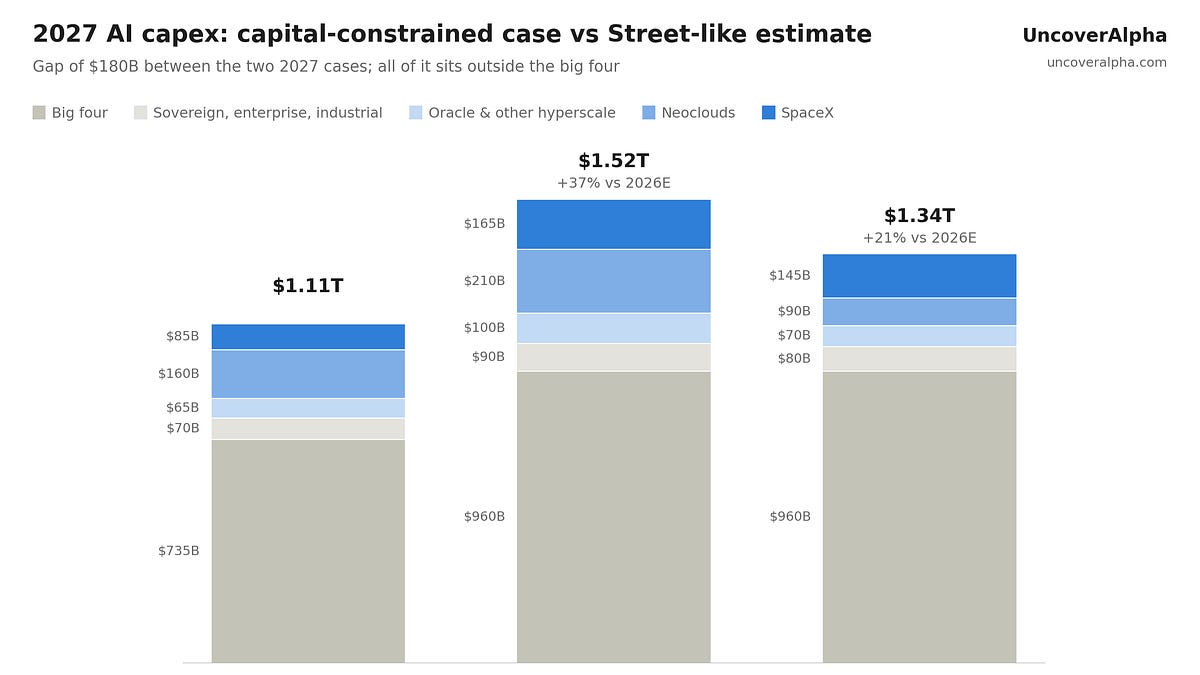
n my capital-constrained model, 2027 AI capex grows about 21% to $1.34T, vs. about $1.52T for a Street-like estimate, and the entire gap sits outside the big four.
The method is simple. Instead of asking how much each buyer wants to spend, I ask how much each buyer group can fund, and from where: its own operating cash flow, debt or equity.
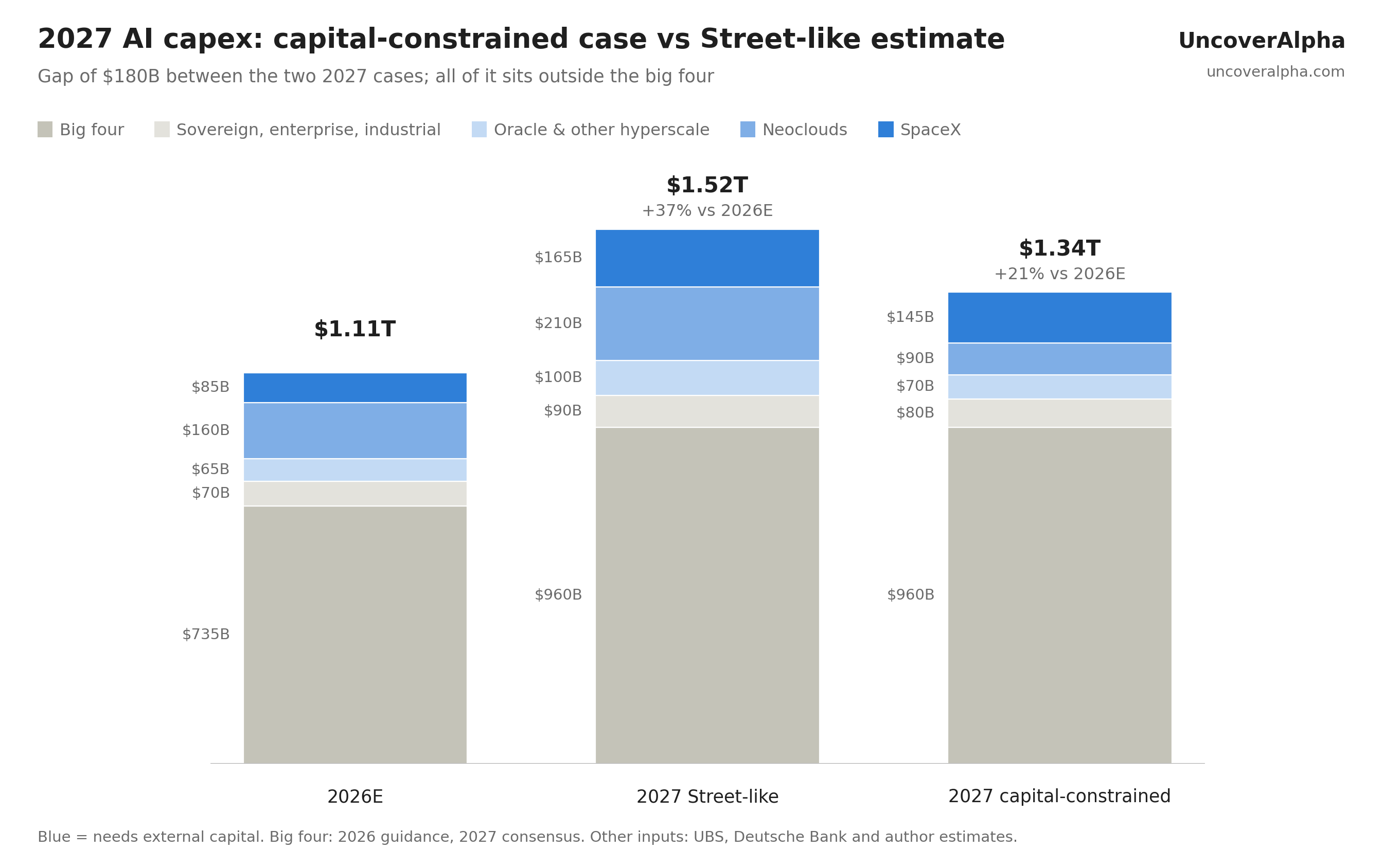
Three things fall out of this model:
1. The hyperscalers become a bigger share of the pie. The big four are ~71% of spend in the constrained case vs. ~63% on the Street path. That is the mix shift that favors in-house silicon, as covered in the semis section.
2. Nvidia’s most loyal buyers stall. Neoclouds plus SpaceX, the buyers that run almost entirely on Nvidia, go from ~$245B in 2026 to ~$235B in the constrained case, roughly flat, vs. ~$375B on the Street path. Those buyers are ~35–39% of Nvidia’s Data Center revenue today. Nvidia guided ~70% revenue growth for fiscal 2028 (≈ calendar 2027); with total capex up ~24% and its most Nvidia-dependent customers flat, growth would land much closer to 25% than 70%, before any ASIC share shift.
3. The labs’ money is the hidden input. Anthropic and OpenAI mostly rent compute: Anthropic bought $482M of property and equipment in H1 2026 against $8.9B of compute expense. Their spending shows up as revenue at the hyperscalers, SpaceX and the neoclouds, and it underwrites those companies’ debt. So when OpenAI struggles to fill a round, it is not just a lab problem. It weakens the collateral behind a large part of the capital-dependent column.
These are estimates, not forecasts, and the neocloud and SpaceX lines carry the most uncertainty. But the direction is what matters: the part of 2027 demand that does not depend on external capital is roughly the big four, and the big four are the buyers with the most leverage over their suppliers.
Now let’s move on to the sections analyzing what this directly means for the semis industry, the neoclouds industry, hyperscalers, and what could alleviate the capital bottleneck in the short term.