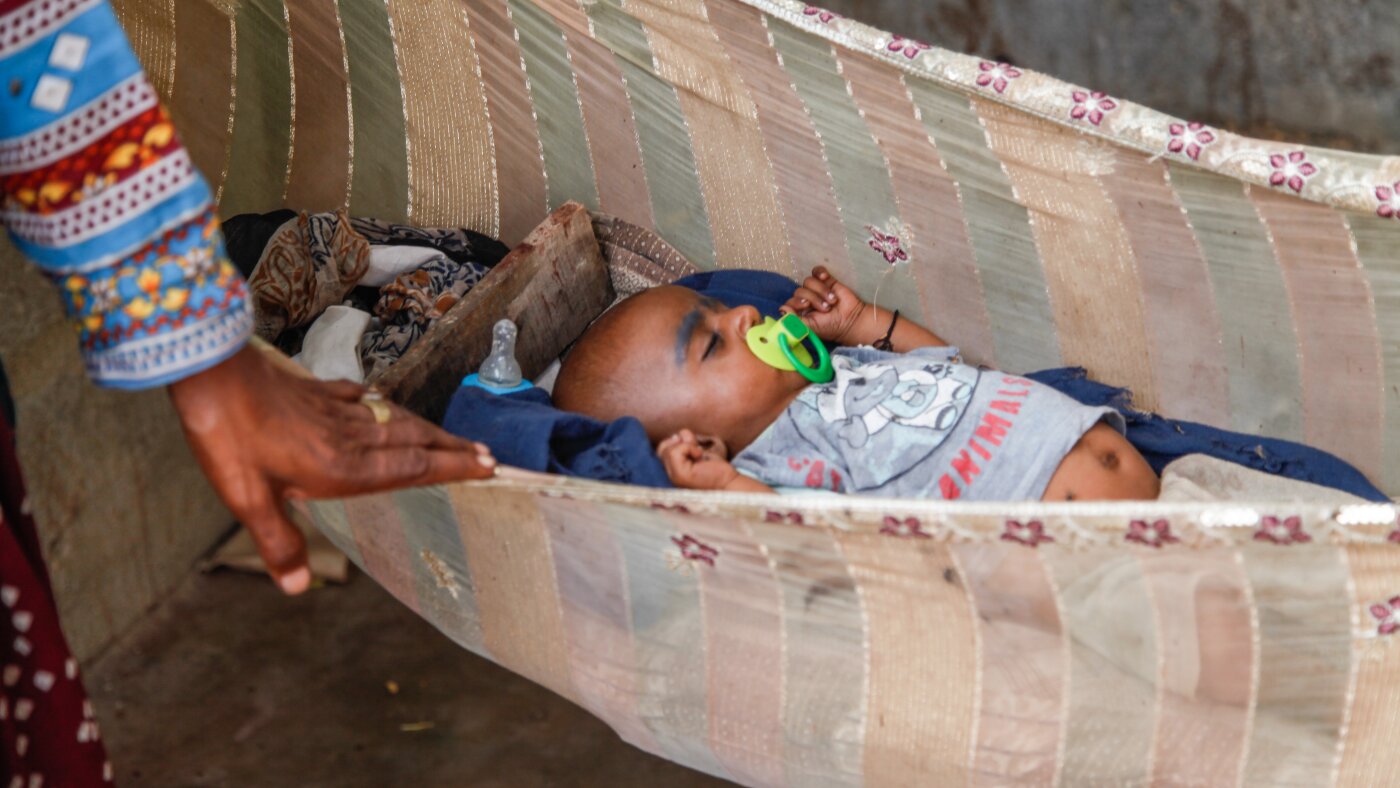
Baby Ladoo’s grandmother, Hanifa, rocks the hammock where the 5-month-old stirs. His mother Mariam, 17, says her son was born prematurely at around seven months gestation. She couldn’t afford follow-up care, so she bought him home and is hoping for the best. About 1 in 4 babies in this fishing settlement of Rehri Goth are born prematurely, nearly double the national rate of 14% — and that’s one of the world’s highest. Scientists in a nearby university say they may have uncovered a bacteria that acts as an indicator of whether a women is likely to birth full term or pre-term.
Diaa Hadid/NPR
hide caption
toggle caption
Diaa Hadid/NPR
REHRI GOTH, Pakistan –- The wind whips up sewage dried to a powder that’s been dumped for years onto an arid riverbed near the fishing settlement of Rehri Goth, on the outskirts of the Pakistani port city of Karachi. In an alley, a man squats over a pile of trash. He fishes out a battered peach and eats it.
It’s here that Sughran lives in a dusty compound with her extended family. She’s only got one name. She doesn’t know her age. Some dozen children mill about in tattered clothes. Five are hers. They’re the survivors.
On the day we meet, Sughran says it has been seven days since she buried her baby Gulshan. He was born at seven months gestation. She says when she felt her contractions quicken, her husband took her to a hospital miles away in Karachi. But she says they wouldn’t admit her because she wasn’t their patient. So she rushed to a local hospital, but it was closed for the night.
“So my family told me to go to another hospital,” she recalls. “I said that I would not go anywhere and decided to deliver the child at home.”
Baby Gulshan was cold by morning.
She buried him in the graveyard near his baby brother Roshan, who died last year. He was also preterm: Sughran says he was also born around 7-months gestation too. “One was alive for eight days, and the second was alive for two hours,” she laments.
While premature babies born in the West have an excellent chance of survival — particularly those born after 32 weeks gestation, or at around 8 months — it’s not the same in low-income countries. The World Health Organization says some half of all premature babies born in poor countries at around 32 weeks are likely to die. Many survivors suffer life-long impacts to their vision and hearing as well as learning problems.
The prematurity rate in Rehri Goth is among the highest in Pakistan: about one in four babies here are born early — before 37 weeks of gestation, according to Dr. Fyezah Jehan, chair of Paediatric Infectious Diseases at Agha Khan University in Karachi, who specializes in maternal health. That’s nearly double Pakistan’s nationwide average of just over 14% percent, already among the world’s highest.
It’s evident why women and girls in this community are having babies prematurely: They’re clearly malnourished. Other factors contribute to early birth, such as the extreme heat and poor sanitation.
Other countries do have the same conditions but prematurity rates aren’t as high as Pakistan’s, says Jehan. “So the question that naturally came to us was, why are the rates so high?”
Jehan says her department “got interested in the microbiome” –- the collection of all the microbes in a human body –- because “we are seeing more and more that the microbiome has a huge role in these adverse pregnancy outcomes.”
Microbes extract vital vitamins and other nutrients, teach the immune systems to recognize dangerous invaders and produce helpful anti-inflammatory compounds and chemicals that can stave off bugs that could make us sick.
The problem was, “we have several studies on the gut microbiome and pregnancy from Western populations, [but] we didn’t have any data from Pakistan.”
And that is key to trying to solve this prematurity puzzle, because a person’s microbiome is partly formed by their diet and local environment.
So Jehan’s team looked at the microbiome of Pakistani women who had just given birth –- by examining their stool. Her team selected 108 samples of feces collected from the area around Rehri Goth over the past two decades. About half were from women who had their babies to term. The other half had premature babies.
And “what we found was — there’s this one bacterium, Prevotella [copri], which was far less in women who had delivered pre-term compared to women who delivered term,” she says. “It was a eureka moment for us. We were like, oh, there is a bug, you know, which could potentially explain prematurity.”
She says so far, the initial study gives them “a signal of risk and a signal of understanding, but they’re by no means at a stage where we can translate it into policy.”
Jehan says her team is replicating the experiment in two different ways. One draws on samples drawn from a different area; the other uses stool samples extracted in different years.
Jehan says they’re also trying to cultivate the bacteria Prevotella copri in the lab. They hope to give it to at-risk pregnant women to see if it helps them get to term.
Dr. Vincent B. Young, an infectious disease physician at the University of Michigan Medical School, says Jehan’s team study is “not necessarily new,” but “it’s confirmatory in a different population than what’s been studied before. I think it adds to the idea that perhaps we can go ahead and intervene in the future.”
But Young cautions, even if Jehan’s team can give isolated Prevotella copri to at-risk pregnant women, it might not do anything. That’s because “association is not causation, right? That just because you see A and you see B, that doesn’t mean A causes B in any way, shape or form,” he says. “But it’s a strong association.”
And even if a lack of Prevotella copri is causing premature birth in some way, giving women more of it may not help. Young explains: “Maybe the reason it’s low is because something else is going on that’s suppressing the level of the Prevotella copri, and just giving more of it – well, that will get suppressed too.”
Young says the study may be useful in a different way — if a lack of Prevotella copri is associated with premature birth — that can be used as a way to identify at-risk women.
Jehan acknowledges there’s no silver bullet to prevent premature births. She says, “if you ask me, improve education and water and sanitation and half the problems will just disappear. What we are doing is really stopgap.”
But Jehan says donors are reluctant to undertake expensive, long-term work like sanitation or girls’ education, when local governments are widely perceived as corrupt. She says that’s why major donors would “rather fund the science” conducted in labs like hers.
A premature baby’s life
Back in Rehri Goth, it feels as if 17-year-old Mariam is fighting against the odds to keep her baby alive. Five-month-old Ladoo fusses in a hammock made from an old scarf. He was born prematurely at around 7 months, his mother says.

Baby Ladoo’s grandmother comforts the 5-month-old, who was born prematurely.
Diaa Hadid/NPR
hide caption
toggle caption
Diaa Hadid/NPR
“The doctor told us that we should take him to the hospital because he doubted whether he would survive.”
But Mariam says there was just no money. “We did not go anywhere, we returned home,” she says. Ladoo has been doing poorly since. “The illness never went away.”
His grandmother Hanifa lifts shirt to show us his stomach is swollen. They don’t know why it’s like that. Scars crisscross his bottom, from blisters that formed in the extreme heat. It was over 113 degrees here for weeks. She pulls out a tiny plastic bag of medicines they keep at the ready for Ladoo. “We are illiterate, and we don’t know which medicines are for which treatment,” his grandmother says.
Now, Ladoo is exposed to even more danger by another hazard many Pakistani women face: advice by health workers that is either ill-considered or so badly communicated that it becomes dangerous.
Mariam says when newborn baby Ladoo was suffering from diarrhea, “I was told not to breastfeed.”
She says she was told to give him formula instead, even though the water in Rehri Goth is unsanitary and dangerous for babies — even if boiled, according to the World Health Organization.
But Mariam can’t even afford formula, which sells for about $2.50 for a small packet in Rehri Goth. So “Right now, we do not have it, so he eats Cerelac.”
That’s a mix of rice powder, milk powder with vitamins and sugar made by the multinational Nestlé. A 25-gram packet, she says, costs the equivalent of 20 cents. The amount of sugar is not listed. It’s mixed with water and given to babies like formula — in a bottle.
The World Health Organization says Cerelac is not suitable as a sole diet for a child of any age. In response to NPR questions, the organization said in a statement that Cerelac “is not formulated to meet the nutritional needs of an infant. It is not sterile and may itself be the source of food-borne illness – even if it is prepared with clean drinking water.” The World Health Organization also said in the statement that the advice to withhold from breastfeeding for Ladoo was “certainly inappropriate and likely dangerous.”
The statement continued, “there are vanishingly few circumstances in which breastfeeding poses a greater danger to an infant’s health than replacement feeding.” That’s because breastmilk helps build a baby’s immunity against potentially deadly diseases.
Nestlé did not respond to detailed questions from NPR about whether it knew its product was being consumed as an alternative to baby formula in a community where women were deeply poor and largely illiterate.
Ladoo’s grandmother shoos away flies that have settled on his milk bottle and feeds the baby. She says, “We know this isn’t good for him but what can we do?”
She says, “We will do what we can to keep this boy alive.”
With additional reporting by Almas Kasmani