Photo-Illustration: by The Cut; Photo: Dr. Shereene Idriss /Idriss Dermatology
Beauty brands make millions each year by selling concealers that promise to cover dark circles and eye creams that promise to banish bags. But under-eye bags are often genetic or come with age, and truly changing their appearance can involve aesthetic treatments like filler or a lower blepharoplasty. But increasingly, doctors and patients alike are turning to something called nanofat grafting: a procedure that involves taking the patient’s own fat from areas like the thighs or stomach, emulsifying it, and injecting it into the desired areas.
“Unlike traditional fat grafting, which is intended to restore volume by transferring intact fat cells, nanofat contains very few viable fat cells,” says Dr. Gary Linkov, a New York City–based double board-certified plastic surgeon. Instead, it has things like stem cells, growth factors, regenerative cells, and connective-tissue components. “The procedure is primarily used to improve skin texture, pigmentation, and overall skin health,” Dr. Linkov adds. According to him, patients can expect to shell out anywhere from $2,500 to upwards of $10,000 for the treatment, depending on location and the provider you choose — remember, you’re paying for both liposuction and the injection.
All of the board-certified physicians we spoke to agreed that interest in nanofat transfer has risen in recent years. Chicago-based plastic surgeon Dr. Sammy Sinno partly attributes it to the popularity of GLP-1’s, and Dr. Goretti Ho Taghva, a plastic surgeon based in Newport Beach, California, says that patients are looking to do more than boost volume — they want the skin itself to look better, too. Additionally, Dr. Shereene Idriss of Idriss Dermatology reported that patients are now more interested in using material from their own bodies rather than synthetic substances like hyaluronic-acid filler. “In the first six months of 2026 alone, I’ve seen about a 10 percent increase in patients choosing these treatments, and I only see that continuing to grow,” she says. It’s easy to see why: According to Dr. Taghva, using your own tissue essentially eliminates the risk of an allergic reaction. (“The real risk is expectation: Patients sometimes want it to do the job of a blepharoplasty, face-lift, or a proper fat graft, and it simply isn’t built for that,” she warns.)
Likewise, other popular procedures used for the under eyes include PRP (platelet-rich plasma) and PRF (platelet-rich fibrin) injections — both use growth factors from the patient’s own blood to improve circulation and encourage collagen production. And while nanofat grafting is a more invasive procedure with a little more downtime, “nanofat carries actual stem cells and micro-vascular tissue alongside those growth factors, so it tends to produce a more durable, more visible improvement in texture and discoloration,” Dr. Taghva says. In other words, nanofat can lead to longer-lasting results. (Although she reports that most patients come back for another round of nanofat after one or two years.)
However, Dr. Linkov warns that, because you’re still injecting something into your face, there’s always the risk of creating a blood-vessel blockage, which can lead to serious conditions like skin necrosis and vision loss. “Although these events are rare, they underscore the importance of careful technique and a thorough understanding of facial vascular anatomy,” he says. “As with any procedure around the eyes or face, nanofat grafting should be performed by an experienced surgeon with detailed knowledge of the regional anatomy.” Furthermore, as Dr. Idriss points out, nanofat may not even be the treatment for you if you’re looking for instant results. “Regenerative treatments take time — often three to six months — and I’d rather tell a patient no than have them choose a treatment that isn’t right for them or their expectations.”
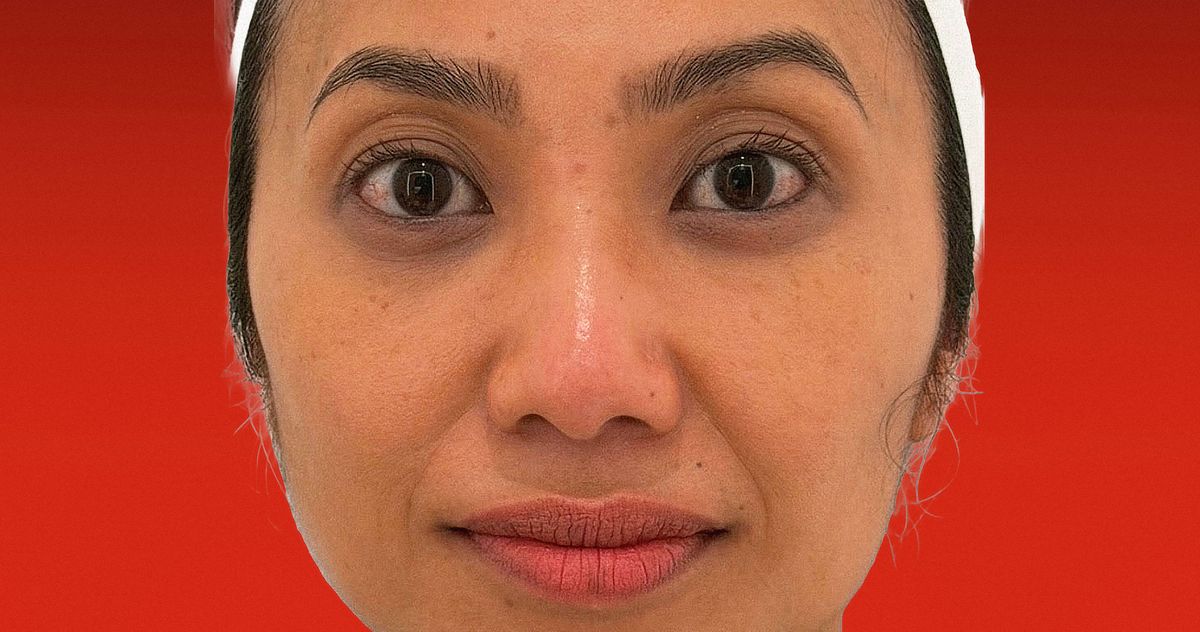
Roxanne, a 43-year-old physician, began noticing unwanted changes in her under-eye area after having two kids. At the recommendation of Dr. Idriss, whom she has been seeing for four years, Roxanne decided to see if nanofat transfer could treat her fine lines, dullness, and under-eye bags. Here, Roxanne shares her experience with nanofat grafting, from her consultation to the results she’s seeing ten months later.
Even when I was a child, I had under-eye bags — I think it’s genetic. But the bags changed over time. Your skin evolves, right? I had noticed that since I had my two children, I looked more tired. I had more lines appearing in that particular area. I was increasingly applying more and more makeup, trying different color correctors, and looking for under-eye moisturizers. I tried to use a green corrector, a lighter corrector. I had been buying so many products for my face and thought to myself, Okay, there’s clearly something evolving on my face. I also wore black eyeliner on my waterline to draw attention to my eyes as opposed to the area underneath. But nothing made me feel like I looked how I used to look before I had children.
I actually didn’t know anything about nanofat transfer until I went to Dr. Idriss, my dermatologist of four years. She told me that the results from a nanofat transfer would be very natural and make my under eyes look more refreshed. I know that some people put filler there, but that really scares me because it’s right by your eye. I liked the idea that my own fat was being used, which felt like the most natural way to enhance that specific area. I also liked that the results are supposed to get better with time. And because Dr. Idriss was the one recommending it, I was like, Sign me up.
This was October of last year, so it was right after my 43rd birthday. I was like, Okay, this is a great present for myself. I went in and lay down on one of the chairs, and Dr. Idriss explained the procedure, as well as its risks, benefits, and alternatives, and then she used a device to take the fat she needed through liposuction. (At Idriss Dermatology, the entire procedure — including the liposuction — starts at $10,000.) No matter how hard I’ve tried, I haven’t been able to lose the fat in my lower abdomen, so I chose to have the fat removed from there. When she went in, she said, “We’ll see if there’s anything.” And sure enough, there was enough for the procedure. I want to say it took about 10 to 15 minutes for her to collect the fat. The cannula she used was tiny, so there wasn’t any pain, really. The lipo was honestly much easier than I expected. It was one of the things I was most nervous about because you hear “lipo” and immediately think you’re going under. But this was done under local anesthesia, so I was awake the entire time, and it was completely different from what I had built up in my head.
After that, she processed the fat in her lab, and she put me in a different room. Then, she injected the fat into the area under the eyes. I’ve gotten Botox before without any numbing, and that was more painful than the nanofat transfer, which I also did without numbing. And I would say that getting filler is the most painful out of the three. The whole thing felt like it took an hour or even less. It’s not something where you feel like you have to take the whole day off. And you don’t go under anesthesia for it, so you don’t need an escort or to have somebody pick you up. Also, I work as a physician, and I think when you learn about the procedure and having fat removed and then fat injected, you think that it would be an intense thing, but there was no downtime. I was surprised, actually.
For post-procedure care, she provided me with a corsetlike garment to suck in the abdomen, which was probably the most uncomfortable part. But I was very familiar with that, because I had two children, and you kind of do the same thing after childbirth so that everything goes back to where it was in the beginning. I wore the corset for a couple days. I was still able to shower and wash my face. I was also advised to wait two weeks before getting a facial or a massage where my face would be flattened on something — just so that everything settles. They were the same kind of recommendations you get when you get Botox and filler.
There wasn’t much of an instantaneous difference. But over the course of the coming days, I noticed that things were starting to look a little bit more glowy, less dull. Even though nobody knew that I had anything done, people at work were noticing that I looked more rested. They asked me what my secret was and what cream I was using. I don’t like it when things look different right away. I look at my face and I’m happy, but because it’s a slow improvement, it’s kind of nice. It feels more natural that way.

Before and after.
Photo: Dr. Shereene Idriss /Idriss Dermatology
The procedure was so painless and easy that I asked Dr. Idriss how often I could get it done. But she said that it’s not something that you need to continue to do, because the results continue to get better for months or even years. It wasn’t this dramatic transformation, but I really do feel like I look so much better than I did ten months ago, and it keeps getting better and better. I never was the type of person who looked into every mirror, but I have to say, when I pass by a mirror now, I like to look at it. Now, my everyday makeup is just some foundation, and then some eye shadow, depending on the day. I don’t have to always put concealer under my eyes, and I don’t put on any eyeliner.
Another upside was that the nanofat transfer made my eyes more symmetrical. I had always had some asymmetry: I had a double fold on one eye and a single fold on the other. I bought some eye tape to try to make things symmetrical — that was a pain and required even more time in my morning routine. No one ever noticed it, but I’m Asian, so I’ve always been conscious of it. But after the procedure, my eyes look the same.
If you’re thinking about getting this done, I can’t underscore enough the importance of ensuring that you have the right person doing it, because there are so many people offering dermatological treatments and procedures. Don’t do it with someone who doesn’t understand all the science behind it. I wouldn’t go to any sort of medical spa that says “nanofat transfer.” I would go to somebody who’s experienced and whose judgment you trust. But if your under eyes are a part of your face that you are constantly feeling conscious about, I think a procedure like this could really help in a very natural way.