Last Updated:
Tattoos in India are shifting from style to symbols of healing, resilience, and memory, with people bringing real stories instead of just ‘Pinterest inspo’



Mental health experiences are deeply subjective. They are difficult to articulate, and often misunderstood even when explained (Image: Representational)
For years, tattoos were discussed in the language of style- placement, colour, size, trend, sleeve here, a minimalist ‘fearless’ line there. But step into a tattoo studio in 2026 and something becomes immediately clear, people are no longer arriving with “Pinterest boards inspo” alone, they are coming in with stories.
Across cities in India, tattoos have quietly shifted categories. They are no longer just fashion statements or markers of rebellion. They are becoming tools for wellness, healing and self-expression, deeply tied to how people process grief, trauma, recovery and identity. This shift is not dramatic or performative. It is slow, deliberate and rooted in meaning.
“Tattoos are a very personalised experience,” says psychologist Ms Akansha Tayal. “The way it is inked on the body creates a sense of permanence. That permanence matters psychologically.”
How Tattoos Reflect Healing And Mental Health?
At the heart of this shift is a simple but profound change. People no longer want their tattoos to just look good. They want them to mean something.
Sunny Bhanushali has observed this change across age groups, cities and backgrounds. “Clients now see tattooing as a deliberate act,” he says. “Many want to process, remember or carry forward experiences. Tattoos serve as quiet records of what’s been endured or reclaimed, not just aesthetic statements.”
This is not limited to metropolitan cities or a specific demographic. Similar conversations are emerging in non-metros, suggesting a broader cultural movement where tattooing sits closer to personal wellbeing and self-understanding than surface trends.
Studio data reflects this shift clearly, Bhanushali, founder at Aliens Tattoo, a pan-India studio network told News18, “In 2024, 624 tattoos were recorded with explicit emotional significance and in 2025, that number rose to 908. Beyond the numbers, the change is evident in how clients engage with the process itself.”
Many consultations now begin with clients explaining why a tattoo matters emotionally before discussing how it should look. Design follows intent rather than leading it, marking a decisive departure from tattoos as purely visual expressions.
Mental health experiences are deeply subjective. They are difficult to articulate, and often misunderstood even when explained. Akansha Tayal, a Noida-based practising clinical psychologist sees this gap repeatedly in her clinical practice. “When people around you keep telling you that what you’re feeling isn’t valid, or that you shouldn’t feel this way, a part of you starts doubting your own experience,” she says. “You begin to wonder whether what you endured was real at all.”
This repeated invalidation can lead to imposter syndrome, depersonalisation and a disconnection from one’s own emotional reality. In such cases, tattoos can become anchors.
“Having something permanently inked on the body becomes a representation of the truth of your experience,” Tayal explains. “It symbolises that what you went through was real. It helps people overcome the shame that often comes from pseudo concern, where care is expressed in ways that invalidate.”
Psychologically, permanence matters as memory fades, language fails but the body remembers. Etching an experience onto skin gives it a stable place in one’s identity.
Can Tattoos Help Health Trauma?
Tayal is clear that tattoos are not inherently therapeutic. Their impact depends on timing, intent and psychological processing. “A tattoo done with conscious choice during a healing phase is very different from one done while someone is still enduring acute pain,” she explains.
In cases of sexual abuse or childhood trauma, tattoos may initially emerge from anger or self-punishment. Tattooing is painful, and that pain can symbolise unresolved rage directed inward.
“When someone is punishing their body, the tattoo can reflect that,” Tayal says. “But as they work on themselves, their relationship with the tattoo often changes.”
What once felt like a reminder of trauma can later become a badge of honour. The determining factor is not the tattoo itself, but the relationship a person has with their psyche and their trauma.
“Tattoos don’t just sit on the body,” she says. “They become part of the psyche.”
Why Do Tattoos Feel Reassuring After Trauma?
Trauma fractures continuity. Life before and after a traumatic event can feel like two separate realities. “In constantly changing lives where there is very little certainty, tattoos become anchor points,” Tayal explains. “They remind people that they survived, and that they are not abandoning themselves.”
Looking at these tattoos during moments of doubt can restore a sense of resilience that feels absent elsewhere. Much like monuments honour collective survival, tattoos become personal markers of endurance.
Why Do Symbols Like Semicolons Carry So Much Weight?
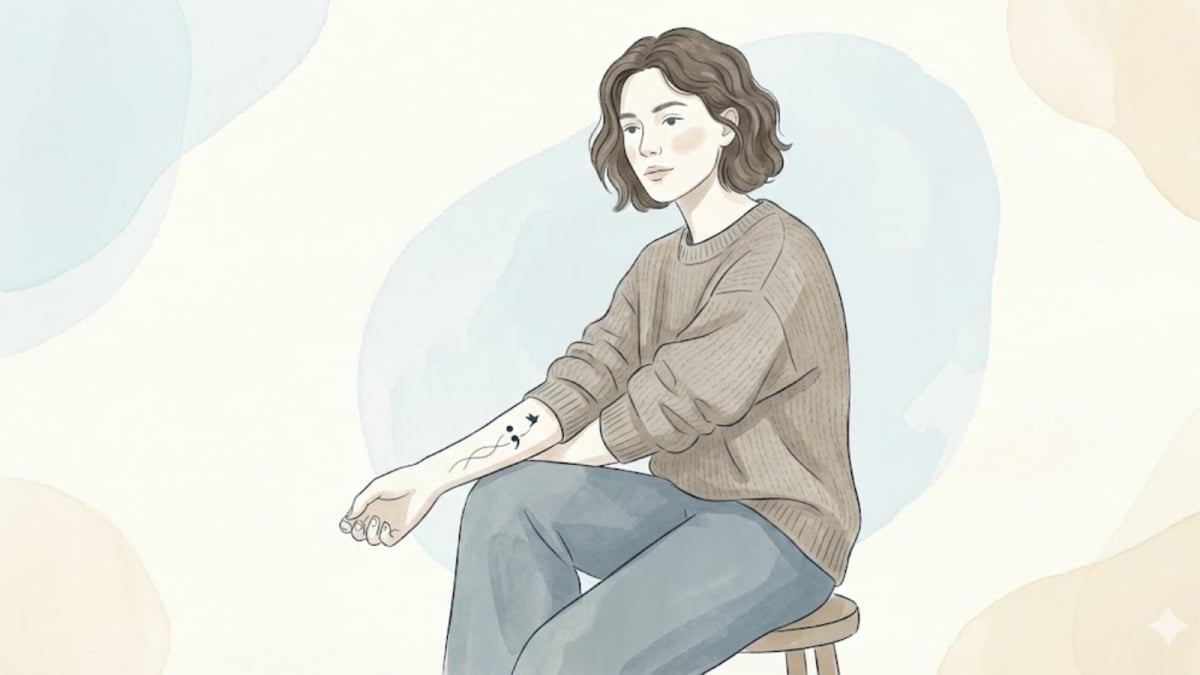
Some tattoos have become widely recognised symbols of mental health survival. Semicolons, for instance, are now understood as markers of resilience after suicidal ideation or attempts.
“I see this often in my practice,” Tayal says. “People who have survived suicide attempts get semicolon tattoos to say, I am a survivor.” These symbols work because they compress complex experiences into a single, recognisable form. They allow people to acknowledge pain without repeatedly narrating it.
They also act as quiet signals. A semicolon on a wrist or a meaningful date on a forearm can invite recognition from others who have been through something similar, without demanding explanation. Beyond personal experiences tattoos also expands to processing personal loss.
For Delhi-based exhibition designer Lata Maheshwari, getting a large, colourful tattoo on her bicep of her two deceased pet rabbits was just a symbol of her love. “They were a huge part of my life,” she says. “Getting them inked felt like carrying them with me, a way to grieve and remember simultaneously.” She adds, “Every time I look at it, it’s a quiet reminder that love and loss coexist, and it gives me comfort.” The tattoo, vivid and detailed, now serves as both memorial and personal anchor, a daily affirmation of her emotional resilience.
How Do Tattoos Create A Sense Of Belonging and Reduce Shame?
“It’s like having a part of her with me,” says Smita Dixit, a Mumbai-based marketing executive. She had a doodle drawn by her late best friend inked on her forearm, a playful caricature the two often shared. “Even on hard days, seeing it reminds me of our bond and the laughter we shared.” She adds, “I wanted something private yet permanent, a symbol only I’d carry, that honours her memory while grounding me.” The tattoo became a bridge between loss and ongoing life, embedding memory into everyday movement.
Shame remains one of the most damaging aspects of mental health struggles. It is internal, but it is also deeply social. “Society makes people feel weak for struggling,” Tayal says. “It pushes them to believe they are outsiders, that something is wrong with them for not coping in a ‘normal’ way.”
Tattoos can disrupt this narrative by creating belonging. When people encounter others with similar tattoos, something subtle but powerful happens.
“It normalises the experience,” Tayal explains. “The shame around surviving a mental health condition starts dissolving.”
From a psychological perspective, this aligns with core human needs. Safety, security and belonging sit at the foundation of emotional wellbeing. Tattoos can meet these needs by forming informal communities of understanding.
What might appear to be a personal choice often functions as a shared emotional language.
What Kinds Of Stories Are People Bringing Into Tattoos?
Tattoo artists are often among the first to hear these stories. According to Bhanushali, certain themes recur consistently across consultations. Mental and emotional wellbeing is a major focus, with clients seeking tattoos that serve as reminders of strength, grounding or stability during periods of anxiety, burnout or emotional strain.
Healing and recovery feature prominently. This includes recovery from illness, addiction or prolonged emotional hardship. Spirituality and faith are increasingly expressed through symbols, mantras and abstract forms that reflect surrender, protection or inner balance.
Sometimes, clients’ grief manifests in unexpected ways. Sunny Bhanushali recounts a striking incident, “One night last year, a customer walked in asking for ‘Maa ka laal’ tattooed across his forehead, big, from one end to the other.” Initially, the team thought he was joking but he was serious. Sunny explains, “He spoke about his mother, her illness, how she wasn’t cared for, and her passing. The grief was heavy.” After a long discussion, he understood the permanence of such a choice and opted for his forearm instead. “Grief can push extreme decisions,” Sunny reflects, “and part of our job is guiding clients safely through that moment.”
Loss and remembrance remain deeply significant. Tattoos honour parents, partners, pets and defining moments tied to grief and memory. Identity and comeback narratives are also common, with tattoos representing reclaiming the self after setbacks, career breaks or periods of reinvention.
Many clients articulate overlapping motivations. A single tattoo may represent memory, belief, resilience and recovery all at once.
January 15, 2026, 18:32 IST

Stay Ahead, Read Faster
Scan the QR code to download the News18 app and enjoy a seamless news experience anytime, anywhere.